In this article
A request arrives at 10 am on Tuesday. An agent replies at 10:10. The customer supplies a missing detail at 12:30 pm, then hears nothing until the following day. The first reply looks fast, but it does not describe the rest of the service.
This illustrative case separates first reply, next reply and resolution. A customer support SLA should identify the event the customer expects, who must act and how its deadline is calculated.
Define three different targets
A useful first reply may request information or explain the next step. The next reply keeps the exchange moving after a new message. Resolution means reaching the defined outcome for the case. Assigning the ticket or sending an automatic receipt does not establish those results.
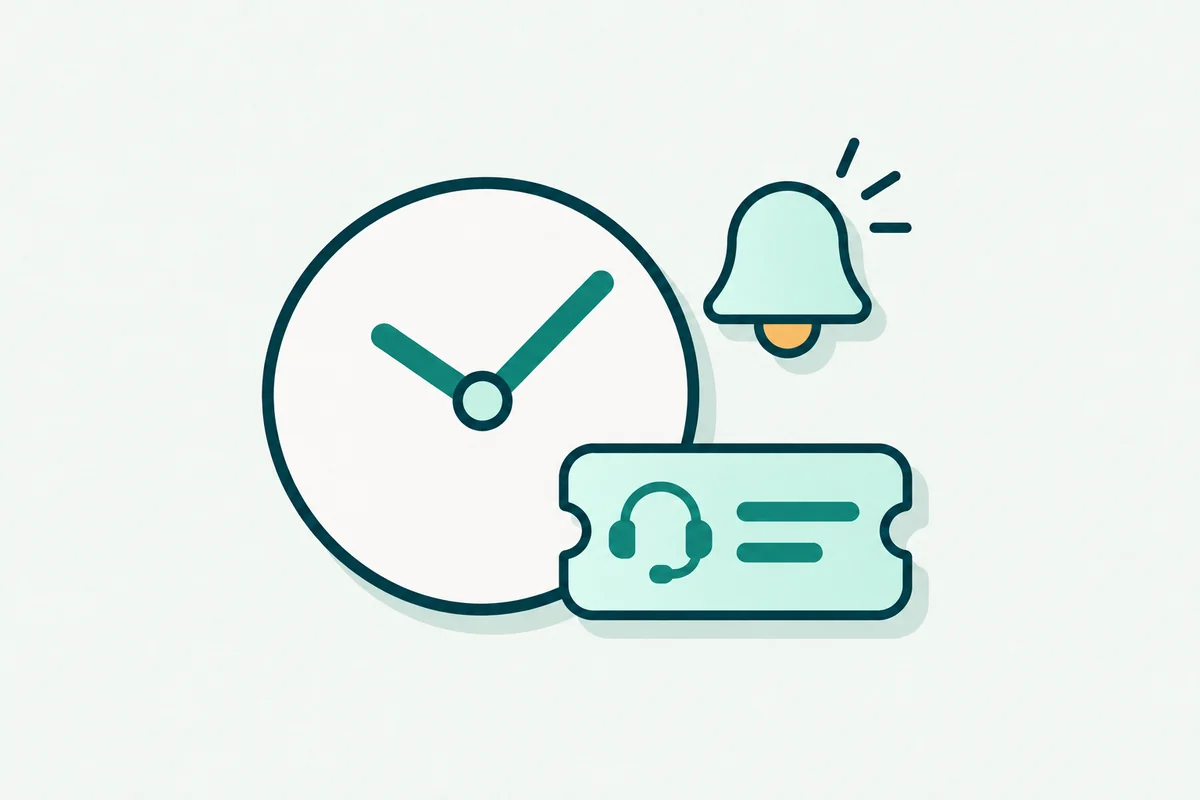
Uppo presents these three clocks in ticket management. Check which event stops each clock in your configuration. An internal note, an AI reply and a human reply should not be treated as equivalent without checking what is actually measured.
For the initial wait, use the first response time guide. Here we define the agreement and test subsequent deadlines.
Write the complete rule before starting the clock
The following is a sample specification. Two hours is a value to test, not a recommendation for every business.
| Item | Example to verify |
|---|---|
| Scope | Ordinary requests received through the support form |
| Target | First public human reply within two working hours |
| Calendar | Monday–Friday, 09:00–17:00, Europe/Rome timezone, defined holidays |
| Starting event | Ticket creation, if that is the event actually measured |
| Warning | The queue owner is notified before the deadline |
| Breach | A manager is informed and the next customer update is assigned |
Two cases for checking deadlines
These targets are illustrative. They assume continuous service during the stated interval, without pauses, holidays or timezone changes.
| Case | Sample target | Expected result |
|---|---|---|
| A customer adds information at 12:30 pm on Tuesday | Next reply within two working hours | A useful reply by 2:30 pm. The first reply at 10:10 am does not satisfy this new step. |
| An ordinary issue opens at 9 am on Wednesday | Resolution within eight working hours | An outcome by 5 pm if no pauses intervene. A reply at 9:10 am does not establish resolution. |
For the second case, define “resolved” first. Can the customer complete the operation, or is another check outstanding? Do not close a ticket simply to stop its clock.
Test priorities, waiting states and reopened cases
“Urgent” in the subject line does not establish priority. Define the impact that justifies the urgent path and who may change it. Then test a priority change after the ticket has opened.
Waiting for a customer may be treated differently from waiting for an internal department. Uppo describes paused clocks while waiting for the customer. Check which states and conditions apply that pause in your environment, then test subsequent messages, reopening, reassignment and holidays. Do not extend the pause to every internal wait because a state has a similar label.
Before making a public promise, verify measured events, conditions and the calendar in your environment. Also define who may approve a priority change and whether its deadline is recalculated. The team should be able to explain the result.
Notify someone who can act
An alert sent to an unavailable person simply moves the problem. Decide who covers the queue and absences. In the test, leave a request unanswered until the warning and check who receives it, when and with what information.
The automations guide explains how to test warnings before a deadline. If a case needs a cross-department decision, a Flow process helps distinguish internal work from customer updates. An activity deadline and a ticket SLA are separate concepts whose behaviour must be checked.
Start with one queue and retain failed cases
Choose a request type. Test an arrival during service hours, one outside them, a priority change, waiting for the customer and reopening. Keep authorised internal references and outcomes; avoid spreading personal data in the report.
Include cases still open. A good result calculated only from answered tickets may hide forgotten requests. Read SLAs alongside backlog and resolution in your customer service KPIs.
Before extending the agreement, ask the team to explain when the next SLA deadline falls. If the answers differ, clarify the rule before changing the number.
Share